






VATICAN CITY — As artificial intelligence reshapes workplaces and corporate decision-making, labor leaders and Catholic bishops are calling for workers to have a direct voice in how the technology is introduced and used.
Their argument is not that technological innovation should be resisted but that decisions affecting jobs, wages, and working conditions should not be left solely to corporate executives or automated systems. Instead, they point to collective bargaining, social dialogue, and human oversight as safeguards for workers’ dignity and rights.
Liz Shuler, president of the American Federation of Labor and Congress of Industrial Organizations (AFL-CIO), said protecting workers requires confronting a model in which executives make far-reaching technological decisions without worker input.
“Right now, we have CEOs who want to play God to make decisions that affect hundreds of millions of working people without our input and consent,” Shuler said.
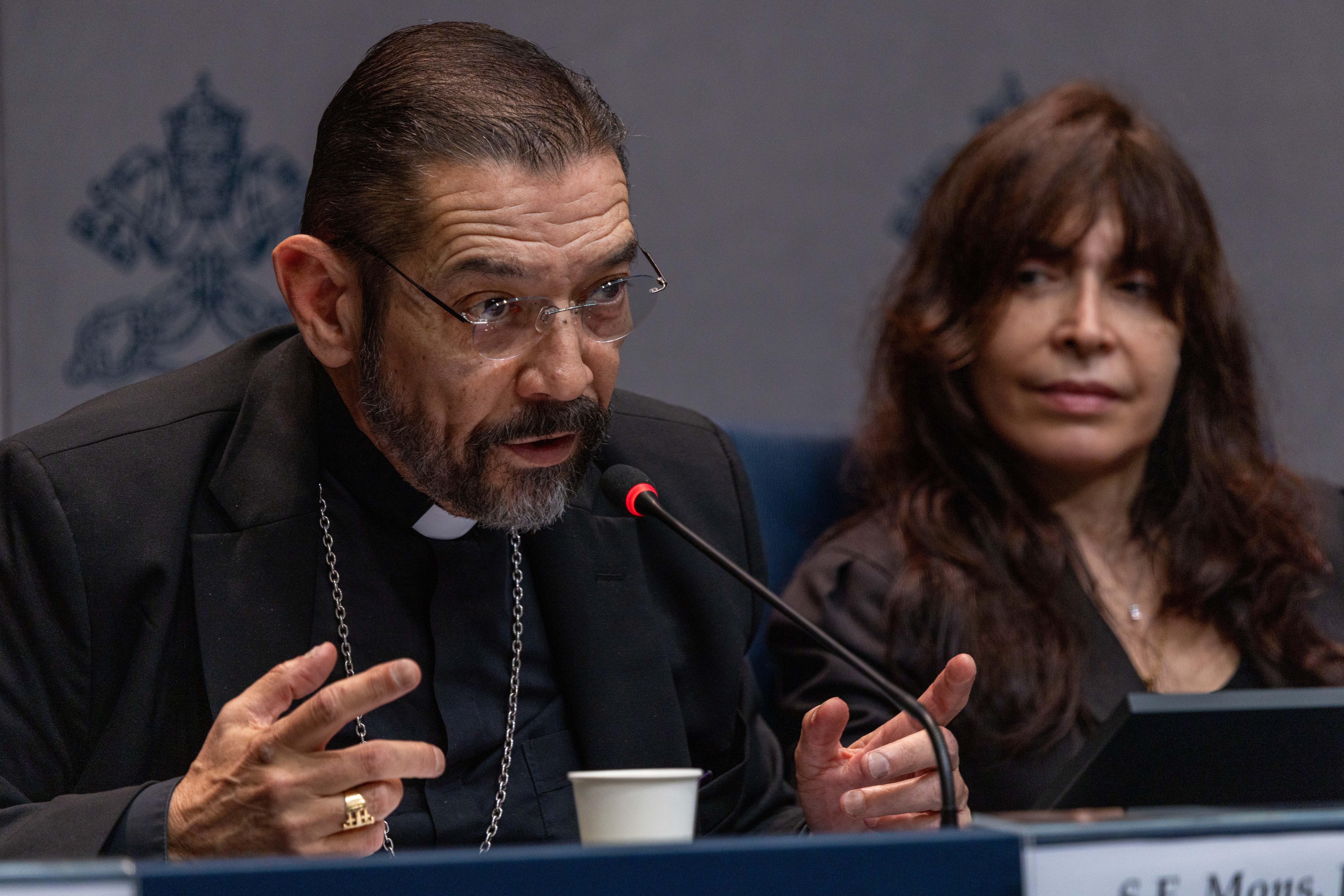
Shuler made the remarks at a Sept. 11 Vatican press conference held in connection with the Fourth Fratelli Tutti Synodal Meeting, a Sept. 10–12 gathering in Rome focused on dialogue between the Global North and South on social and environmental issues. The press conference brought together labor and Church leaders to discuss, among other questions, the impact of artificial intelligence on workers and the need for social dialogue. Other speakers included Bishop Daniel Flores, vice president of the U.S. Conference of Catholic Bishops; Cardinal Jaime Spengler; and labor leader Gerardo Martínez.
For Shuler, social dialogue is essential to ensuring that AI is developed and deployed with human dignity in mind. She compared the current technological transition to the introduction of electricity during the second industrial revolution.
“Electricity was a new technology that was raw and revolutionary and dangerous, and companies were racing to make profits and people were suffering,” she said.
Shuler linked that history to Pope Leo XIII’s 1891 encyclical Rerum Novarum, which addressed the relationship between labor and capital. It was “workers organizing together in a union who stood up to demand safety from the government, from power companies, and negotiated to make sure electricity was installed and used responsibly to benefit everyone,” she said.
She also pointed to the partnership between the AFL-CIO and Microsoft as an example of how organized labor can seek a formal role in the development and introduction of AI.
Shuler said the agreement “guarantees workers a voice in the development of AI” and “puts into writing our workers’ right to form a union.”
Martínez similarly argued that worker protections need not come at the expense of technological innovation. He summarized the labor movement’s approach in three principles: “Not resisting innovation, not accepting exclusion, and negotiating transition.”
Under that approach, unions do not reject technological advances but insist that automated systems should not independently determine fundamental working conditions.
“We cannot accept that an algorithm decides by itself about employment, salary, and rights that correspond to a worker,” Martínez said.
He said the objective should be integration rather than a confrontation between workers and technology: “The challenge is not technology against work. The challenge is technology with worthy work, productivity, distribution, and development with social justice.”
Flores connected the issue of worker participation to Catholic social teaching, particularly the principle of subsidiarity and the importance of allowing communities affected by technological change to express their concerns.
“From the Catholic point of view, history is not always a matter of what the powerful decide, that there are other things that move history,” Flores said. “One of them is social friendship, and a sense of justice, and a sense of what is right.”
Those themes also figure prominently in Pope Leo XIV’s encyclical Magnifica Humanitas, which addresses the protection of human dignity amid the development of artificial intelligence.
Spengler cited the encyclical’s call to each generation to shape technological and social change in accordance with human dignity: “Each generation inherits the task of shaping its own era, of guiding history to become a place where the dignity of every person is safeguarded, justice is promoted, and fraternity is made possible.”
Taken together, the speakers presented worker participation as a central question in the development of AI. Their proposed safeguards include collective bargaining, negotiated technological transitions, human oversight, and cooperation among unions, employers, international organizations, and faith communities — with the aim of ensuring that innovation serves workers rather than leaving consequential employment decisions to algorithms alone.










Leave a comment