






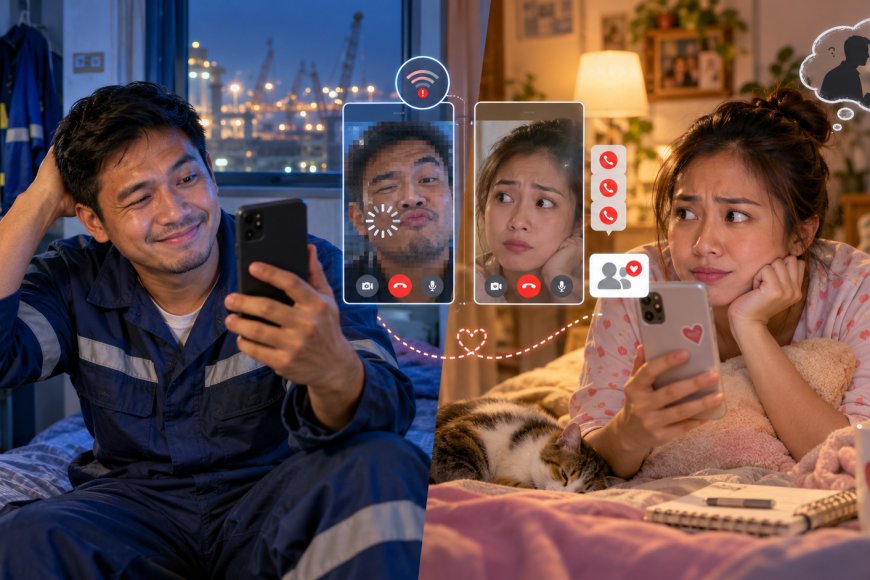
Long-distance relationships are difficult. Long-distance relationships involving an OFW are a special category of difficult—somewhere between maintaining a marriage, managing an international company, and investigating a crime that may not have happened.
For millions of overseas Filipino workers, love is kept alive through video calls, voice messages, remittances, screenshots, scheduled arguments, and the sacred question:
“Nasaan ka?”
The answer may be perfectly innocent.
“On the bus.”
But because the camera is turned off, the imagination immediately begins producing a full-length teleserye.
“Why is your camera off?”
“Low battery.”
“Why is your battery low?”
“I used my phone all day.”
“Who were you talking to all day?”
And just like that, a simple battery problem becomes a Senate investigation.
Love According to the Clock
An OFW relationship often operates in two time zones and three emotional conditions.
When one partner is waking up, the other is preparing to sleep. When one wants to talk, the other is at work. When both are finally available, the internet suddenly decides to become shy.
“Can you hear me?”
“Yes.”
“What did I say?”
“You said something.”
“What something?”
Then the screen freezes in the least flattering position possible—mouth open, eyes half-closed, looking like someone who has just received terrible news from the dentist.
Still, couples continue calling.
They talk while eating, commuting, folding laundry, cooking, or lying in bed. Sometimes there is nothing important to say, but hearing an ordinary voice from home can make an unfamiliar country feel less lonely.
The call may only last five minutes.
“Have you eaten?”
“Yes.”
“What did you eat?”
“Chicken.”
“What kind of chicken?”
“Fried.”
“With rice?”
“Yes.”
To outsiders, the conversation sounds painfully boring.
To an OFW, it sounds like home.
Some long-distance couples have a communication routine more organized than a corporate office.
Good morning message: required.
Lunch update: expected.
Photo of food: highly encouraged.
Video call after work: mandatory.
Good night message: non-negotiable.
Failure to complete any of these may result in emotional penalties.
An unanswered message for twenty minutes can cause concern.
An unanswered message for two hours can cause suspicion.
An unanswered message for six hours can produce a complete imaginary second family.
The OFW may simply be working overtime.
Meanwhile, the partner in the Philippines has already examined the last-seen status, profile picture, Facebook likes, tagged photos, and the online activity of a co-worker named “Jenny.”
Jenny may be 63 years old and married with six grandchildren.
It does not matter.
Jenny has now entered the investigation.
Remittance Is Not a Love Language—But Sometimes It Feels Like One
OFWs often show love through sacrifice.
They send money for tuition, groceries, electricity, medicine, rent, birthdays, emergencies, and problems that apparently multiply whenever payday arrives.
Sometimes, the partner back home says:
“I don’t need anything. I only need you.”
This is romantic.
Five minutes later:
“By the way, the refrigerator is making a strange sound.”
The OFW understands immediately.
The refrigerator is about to become part of the relationship.
Money can create pressure in long-distance love. The OFW may feel valued only as a provider, while the partner at home may feel abandoned emotionally even when the bills are paid.
Both may be making sacrifices, but neither always sees the other’s sacrifice clearly.
One is working in a foreign country, missing birthdays and family dinners.
The other is managing the household, raising the children, solving problems alone, and pretending not to worry.
One sends money.
The other sends strength.
Both become tired.
And both sometimes forget to say, “Thank you.”
Jealousy Has Excellent Internet Connection
Poor Wi-Fi cannot stop jealousy.
Jealousy can travel across oceans without delay.
A harmless group photo can create trouble.
“Who is the person beside you?”
“My co-worker.”
“Why is she standing close?”
“There were twelve people in the photo.”
“But why beside you?”
“Because that was where she was standing.”
“Why was she standing there?”
At this point, even the OFW no longer knows.
Long-distance relationships require trust, but trust becomes difficult when couples only see fragments of each other’s lives.
The partner back home sees a new friend in a photo but does not see the lonely dinner afterward.
The OFW sees the partner attending a party but does not see how early they went home.
Distance leaves empty spaces, and fear likes to fill them.
This is why mature couples ask questions before making accusations.
They say, “I felt worried,” instead of, “I know you are cheating.”
They say, “Please explain,” instead of sending twenty-seven angry messages followed by:
“Never mind.”
In Filipino relationships, “never mind” almost never means never mind.
It usually means, “You have one final opportunity to answer correctly.”
The Children Grow Through a Screen
For OFW parents, the most painful part of long-distance love is often watching children grow through photographs and video calls.
A child loses a tooth.
A child receives an award.
A child learns to read.
A child becomes taller.
The OFW celebrates from thousands of kilometers away.
Sometimes the child becomes quiet on the phone.
Sometimes they are more interested in a toy than speaking to Mama or Papa.
The parent laughs and says, “Okay, go play.”
Then the call ends, and the room becomes silent.
This is the side of OFW life that photographs rarely show.
There may be a smiling picture in front of a famous landmark, but behind it is a parent who missed a school program.
There may be a new handbag or winter coat, but behind it is someone eating alone after a long shift.
There may be a successful life abroad, but success can still feel incomplete when the people you love are sleeping on the other side of the world.
Arguments Become International Events
Normal couples can argue face-to-face and eventually calm down.
Long-distance couples may argue through chat, where punctuation becomes dangerous.
“Okay.”
Is it really okay?
“Fine.”
It is definitely not fine.
“K.”
This may indicate the beginning of a diplomatic crisis.
Text messages do not carry facial expressions. A joke can sound insulting. A delayed reply can look intentional. A tired person can sound cold.
Before long, two people are arguing about the tone of a message that only contained one word.
The wiser couples eventually learn not to solve serious problems through chat.
They call.
They listen.
They allow silence.
They remember that the person on the screen is not the enemy. The enemy is often exhaustion, loneliness, insecurity, and the distance itself.
Homecomings Are Beautiful—and Sometimes Awkward
Everyone imagines the airport reunion.
The OFW arrives.
The family runs forward.
There are tears, flowers, hugs, and dramatic background music that no one actually hears.
It is beautiful.
But after the reunion comes adjustment.
The OFW has developed new habits. The family has created new routines. The children may feel shy. The couple may need time to become comfortable again.
One partner may want romance.
The other wants to sleep for fourteen hours.
One wants to go out.
The other wants to inspect the leaking roof they have been paying to repair for two years.
Love must be reintroduced into daily life.
Not movie love.
Real love.
The kind that includes traffic, groceries, snoring, relatives, unpaid bills, and someone asking where the phone charger went.
The strongest long-distance relationships are not perfect. They are intentional.
They communicate even when the conversation is ordinary.
They do not use silence as punishment.
They discuss money honestly.
They create realistic plans for reunion.
They protect each other from unnecessary suspicion.
They understand that being busy is not the same as being uncaring.
They also create small rituals.
A Sunday video dinner.
A morning voice message.
Watching the same movie from different countries.
Praying together.
Sending surprise food deliveries.
Celebrating anniversaries through a screen, even when one person is wearing pajamas and the other is hiding in the staff room during a break.
These small acts may look simple, but they tell the other person:
“You are still part of my daily life.”
OFW relationships are often praised for surviving.
But love should not only survive. It should still feel alive.
It needs laughter.
It needs affection.
It needs honesty.
It needs plans.
It needs reassurance that is given freely, not only after an argument.
An OFW should not be treated only as a source of money.
The partner at home should not be treated only as someone expected to wait.
Both deserve appreciation.
Both deserve loyalty.
Both deserve to feel that the sacrifices have meaning.
Because long-distance love is not simply about counting the days until someone comes home.
It is about making sure there is still a loving home—and a loving relationship—to return to.
Love Across the Distance
Behind every OFW love story are missed birthdays, unstable connections, delayed flights, secret tears, and countless messages asking:
“Have you eaten?”
It may not sound like poetry.
But for Filipinos, sometimes that question carries everything:
I miss you.
I worry about you.
Please take care of yourself.
I am still here.
And perhaps that is how long-distance love survives—not through grand promises, but through ordinary faithfulness repeated every day.
One call.
One message.
One remittance receipt.
One misunderstanding successfully resolved.
One “good night” sent across the ocean.
Until distance finally becomes an airport arrival, a familiar embrace, and the beautiful sound of someone saying:
“You’re home.”











Leave a comment