




There comes a moment in the life of an OFW when he quietly realizes, “Maybe I have finally made it.” It is not always the day he receives a promotion. It is not when he posts a photo beside a famous landmark. And it is definitely not when he uploads a picture holding a shopping bag from an expensive store—especially when the bag is borrowed from a friend.
Success often arrives in a much quieter way.
It may be the day his mother tells him, “Anak, bayad na ang utang natin.”
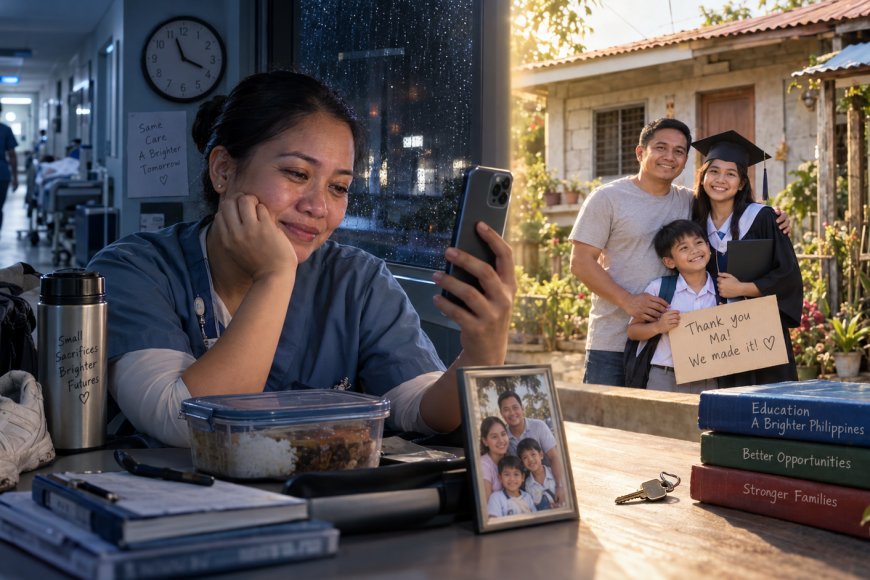
It may be the moment his younger sibling graduates and sends him a photo wearing a toga.
It may be when the leaking roof back home is finally repaired, the family refrigerator is no longer held together by tape, or the monthly electric bill no longer causes a family emergency.
That is when an OFW begins to feel successful.
First, he celebrates carefully.
He buys himself a good meal without checking the price three times. He orders dessert, even though his practical OFW brain whispers, “That money could already buy one sack of rice.”
He may finally purchase a watch, a pair of shoes, or a phone that is not already three models behind.
Then, naturally, he takes a photo.
Not because he wants to show off, but because after years of sacrifice, he finally has proof that life is improving.
Still, a successful OFW rarely spends only on himself.
He sends more money home.
He pays for medicine, school fees, house repairs, baptism celebrations, weddings, birthdays, and sometimes even expenses for relatives he barely remembers meeting.
Once people hear that an OFW is doing well, his inbox suddenly becomes more active than a customer-service hotline.
“Kuya, baka puwedeng makahiram.”
“Tito, may school project po.”
“Pinsan, investment opportunity ito.”
Some opportunities are real.
This is where success becomes complicated.
An OFW who has struggled for years may feel guilty saying no. He remembers what it was like to have nothing. He wants everyone he loves to experience comfort too.
But true success is not measured by how many people can withdraw from your wallet.
It is measured by whether your sacrifices created stability, dignity, and a future.
A successful OFW begins to understand that helping does not always mean giving cash.
Sometimes helping means paying directly for tuition instead of handing over money.
Sometimes it means teaching a family member how to save.
Sometimes it means refusing to finance another business idea involving milk tea, online selling, or pigs that somehow never become full-grown.
He also begins preparing for himself.
He builds savings.
He buys insurance.
He invests carefully.
He plans where he will live when he returns home.
He starts asking an important question: “What happens when I can no longer work abroad?”
Because the greatest success of an OFW is not staying overseas forever.
It is having the freedom to choose.
To return home without fear.
To stay abroad without desperation.
To wake up knowing that his family is safe, his debts are manageable, and his future no longer depends entirely on the next salary.
But even after all the achievements, there is often one thing missing.
Time.
The children he supported may have grown up while he was away.
The parents he wanted to give a better life may now walk more slowly.
The house he built may be beautiful, but his room inside it may still feel unfamiliar.
That is why many successful OFWs eventually realize that money was never the final dream.
The dream was to come home with peace.
To sit at the family table without counting the days before the next flight.
To hear laughter in person instead of through a phone.
To become part of the life they worked so hard to support.
So, what does an OFW do when he finally feels successful?
He celebrates.
He shares.
He saves.
He learns to say no.
And, most importantly, he begins planning a life where success is no longer measured by how far he had to travel—but by how close he can finally be to the people he loves.









Leave a comment