





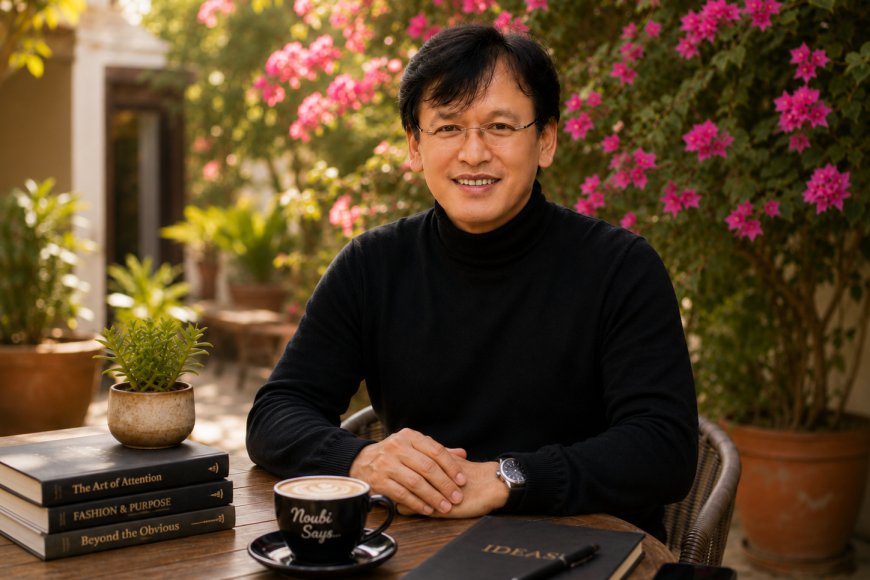
From San Francisco fashion and Seattle reinvention to discovering Prague and embracing artificial intelligence, Noubikko reflects on a life shaped by friendship, observation and an enduring curiosity about people.
July 4, 2026 – Milan, Italy — For designer and entrepreneur Noubikko, a cup of coffee has never been merely a drink. It is an invitation to listen, observe and discover the stories of the person sitting across the table.
In a deeply personal conversation titled “Coffee With Noubikko: Notes From a Life Lived Across Continents,” he reflects on the cities, friendships, industries and unexpected opportunities that shaped his life—from San Francisco, to Seattle and Vancouver to the historic streets of Prague.
The conversation explores how curiosity has allowed him to remain connected with a rapidly changing world, particularly through technology and artificial intelligence.
“My life is difficult to explain in one title,” Noubikko says. If you ask me “The answer depends on which decade of my life you are asking about.”
At different stages, through the years, his work has involved fashion, restaurants, real estate, and community projects. Yet as he looks back, he says the people he encountered have become far more meaningful than the professional titles he accumulated.
“As years pass, I become less interested in titles,” he explains. “People are more interesting than professions. Stories are more meaningful than achievements. And a sincere conversation is often more memorable than any formal presentation.”
San Francisco Was a Friendship City
Many people associate Noubikko’s San Francisco years with fashion shows, designers and glamorous events. But the spectacle of the fashion industry is not what he remembers most.
He remembers the friendships.
“The fashion shows were really an excuse for everyone to come together,” he says. “The true magic happened before and after.”
Those moments often unfolded over coffee, dinners and conversations that began with fashion but eventually moved toward relationships, dreams, disappointments and the ordinary struggles of life.
“Looking back, San Francisco was never only a fashion city for me,” he says. “It was a friendship city.”
Among the people he remembers are designers, artists, entrepreneurs and friends who became part of the cultural life of the city. He recalls the late Filipino designer Ito Curata not simply as a celebrated fashion personality, but as “Ito”—a friend, a guest at his fashion shows and someone with whom he shared ideas and laughter.
He also remembers Ernesto Villaruel and close friends such as Saysay Torillo, Nardo and Edna.
“There were no appointments and no formalities,” Noubikko recalls. “Coffee somehow appeared. Stories appeared. And the hours disappeared.”
He also remembers encountering personalities connected with the broader fashion community, Jessica McClintock, Halston and members of the Esprit creative circle.
“At the time, they were not legends,” he says. “They were simply people trying to create something. History has a habit of turning ordinary friendships into extraordinary memories.”
When a Beloved City Changed
The San Francisco Noubikko remembers was full of creative energy, ambition and possibility. But the city also experienced profound loss.
The AIDS epidemic took the lives of many people who helped define that era. “The city remained beautiful, but it felt different,” he says. “The familiar faces became fewer. The conversations became quieter. The energy that had once seemed endless slowly began to fade.”
Noubikko says he does not remember making a single conscious decision to leave San Francisco.
Instead, he gradually understood that one chapter of his life was ending.
“The difficult part about loving a city is accepting that it will not remain the way you remember it,” he says. “People leave. People retire. People move on. And sometimes, they leave permanently.”
Seattle and Vancouver Offered Space to Breathe
After the intensity of San Francisco, Seattle gave Noubikko something he did not realize he needed: space.
In Seattle, he met fashion model Giulliano Russelli. Together, they established Moda Fashion Magazine and continued developing the Noubikko brand.
The most important lesson Seattle offered was not necessarily about fashion or business.
It was about stillness.
“People often believe that success comes from constantly moving and constantly doing something,” Noubikko says. “But sometimes, success comes from sitting still long enough to understand what has already happened.”
Vancouver offered a similar sense of perspective.
“Both cities helped me rediscover something ” he says. “Life does not always have to be dramatic. Sometimes, it is enough simply to breathe.”
Discovering Prague After 26 Years in America
A new chapter began in 2001 when Noubikko’s best friend, Saysay, invited him to visit Prague.
He remembers seeing Prague’s Old Town for the first time and immediately feeling an unexpected sense of belonging.
“The first words that came out of my mouth were, ‘Oh my God, I’m home,’” he recalls.
After 26 years in the United States—including four years in Seattle—he decided to move to the Czech capital.
There was no elaborate business plan or carefully prepared relocation strategy.
“I simply left,” he says. “People like to imagine that life unfolds according to a carefully prepared strategy. Mine rarely did.”
Noubikko arrived during a very different period in Prague’s history. The Czech Republic had not yet joined the European Union, and the Filipino community was still extremely small.
At the time, he recalls that there were approximately 36 Filipinos living in the country.
“If a Filipino arrived in Prague, practically everyone in the Filipino community knew about it,” he says.
For Noubikko, Prague felt undiscovered—not because the world did not know the city existed, but because it had not yet become the international destination it would later become.
“Prague felt like a secret,” he says. “And I have always been fascinated by secrets.”
The Accidental Restaurateur
Although fashion had defined much of his earlier professional life, it was not initially part of Noubikko’s plan in Prague.
“In 2001, fashion still seemed to belong to cities such as Paris and Milan,” he explains. “Prague looked different to me. It looked like an opportunity.”
So he bought a restaurant.
Then he bought another.
And eventually, another.
He would discover older establishments, renovate them, make them attractive, operate them and later sell them.
“Looking back, I probably spent several years accidentally becoming a restaurateur,” he says.
The ventures were not part of a complicated investment model. They grew from his willingness to observe the city and respond to opportunities as they appeared.
“Sometimes, people give complicated names to things that began with very simple decisions,” he says.
Before Short-Term Rentals Became a Global Industry
Noubikko also recognized that furnished apartments could become a viable business.
Long before short-term rental platforms became internationally known, he was, furnishing them and renting them to visitors who wanted to experience Prague as residents rather than conventional tourists.
“Nobody called it a startup,” he says. “Nobody called it disruption. Nobody called it innovation. It was simply common sense.”
The apartment business helped him survive and establish a new life in a new country.
“Sometimes, innovation is simply noticing what people need before everyone else gives it a name,” he says.
When Fashion Found Him Again
Although Noubikko believed he had moved away from fashion, the industry soon returned to his life.
“The funny thing about life is that when you turn in the wrong direction—or try to run away from something—the right path often finds you even faster,” he says. “I thought fashion was no longer my priority. Apparently, fashion disagreed.”
He eventually became involved with Miss Czech Republic for Miss Universe Pageant, reconnecting him with the fashion and pageant industries.
One of his Prague restaurants developed into a gathering place for models, photographers, actors, filmmakers, artists and young creative personalities. Located near Prague’s internationally respected film academy, the establishment gave him daily access to people who were only beginning their careers.
“At the time, I thought I had simply purchased a restaurant,” he says. “What I had actually purchased was a front-row seat to the future.”
Many of the students, actors and artists who passed through the restaurant would later become successful. At the time, however, they were simply young people pursuing their dreams.
“And now that I think about it,” Noubikko says, “that was exactly what all of us were doing.”
When Philippine Television Came Calling
As stories about his life in Europe reached the Philippines, Noubikko attracted the attention of the television program Pinoy Meets World.
The program wanted to document his life, businesses and experiences in Europe.
“I was not trying to be in the lime light,” he says. “I was simply living my life—meeting people, building businesses and creating friendships.”
He never considered his personal journey particularly unusual. He believed he was simply following opportunities and allowing his curiosity to guide him.
“Apparently,” he says with humor, “curiosity makes good television.”
The Most Expensive Coffee
Having lived and traveled in different parts of the world, Noubikko has enjoyed coffee in cities including Paris, Prague, Vienna, San Francisco and Tokyo.
But when asked about the most expensive coffee he ever had, his answer has nothing to do with price.
“The most expensive cup of coffee was the one from which I learned nothing,” he says.
For him, the true value of coffee is determined by the conversation accompanying it.
“Sometimes, a three-euro cup of coffee can change your life,” he explains. “Sometimes, a twenty-euro cup of coffee is completely forgettable. The true value is not in the cup. It is in the person sitting across from you.”
A Quieter Definition of Luxury
Noubikko’s understanding of luxury has also changed with age.
“When I was younger, luxury had to look impressive,” he says. “Today, luxury feels peaceful.”
His modern definition of luxury is simple: a quiet apartment, a comfortable chair, reliable internet, a beautiful view, a good cup of coffee and enough time to appreciate them.
“The more I realize that the finest things in life rarely announce themselves,” he says. “They arrive quietly. And when you are paying attention, you notice them.”
Curiosity as a Life Strategy
Throughout every chapter of his life, Noubikko says two qualities remained constant: curiosity and learning what is new.
He has always enjoyed observing people, identifying patterns and asking questions.
Why is one restaurant full while another remains empty? Why does one city feel alive while another feels tired? Why does one person appear fulfilled while another seems unhappy?
“Curiosity has introduced me to most of the opportunities I have ever had,” he says. “It has also introduced me to most of the people I treasure.”
For Noubikko, paying attention means more than simply looking at the world. It means observing it closely enough to understand what it may be trying to teach.
“Most people are looking,” he says. “Very few are observing. There is a difference.”
He believes people must remain willing to learn, adapt and update the ways they think and communicate.
“You cannot live entirely in the past and expect to understand the present,” he says. “The world continues to change, and we must be willing to change with it—not by abandoning who we are, but by updating the way we think, communicate and participate.”
Artificial Intelligence and a New Generation
Artificial intelligence represents one of the most significant changes Noubikko has witnessed during his lifetime.
Rather than viewing AI primarily as a threat, he describes it as “the ride of the century.”
“At my age, I find it exciting that I can still learn something completely new,” he says.
Technology, he explains, has allowed him to communicate with younger generations—particularly Generation Z—on more equal ground.
“We may come from different times, but curiosity gives us a common language,” he says. “They teach me how they see the future. Perhaps I can help them understand something about the past.”
Noubikko believes experience and innovation should not compete with one another. Instead, they can work together.
“For the first time, several generations can sit at the same table and explore the future together,” he says. “Experience no longer has to compete with innovation. The two can strengthen each other.”
Teaching Technology the Meaning of Kindness
While Noubikko enthusiastically uses artificial intelligence to explore ideas, develop stories and communicate across generations, he also believes technology must be approached responsibly.
“I understand that artificial intelligence does not experience kindness the way human beings do,” he says. “It does not have a heart. It does not have memories. It does not feel compassion in the way we do.”
Nevertheless, he believes human beings can help technology understand the principles associated with kindness.
“We teach it through the questions we ask, the words we choose and the values we bring into every conversation,” he explains. “Technology may provide the intelligence, but human beings must provide the humanity.”
For Noubikko, the greatest value of AI is not simply its ability to produce information quickly. It can also help preserve stories, explore ideas, communicate across age groups and allow people to continue learning throughout their lives.
“AI helps me remain connected with the present,” he says. “It allows me to communicate with younger people not as someone who belongs only to the past, but as someone who is still participating in the future.”
However, he warns that technology should never be allowed to replace human compassion.
“It should help us express kindness more clearly, share it more widely and remind us that progress means very little if we forget how to care for one another.”
One More Conversation Over Coffee
Looking back at San Francisco, Seattle, Vancouver, Prague, fashion, restaurants, travel, friendships and technology, Noubikko identifies two threads connecting every chapter.
Curiosity and never giving up on innovation.
“I never stopped being curious,” he says. “And I never stopped believing that every person has a story worth hearing.”
It helped him understand the world he came from while encouraging him to participate in the world still being created.
And preferably, he adds, the conversation should continue over coffee.
“Fashion introduced me to people. Curiosity taught me how to appreciate them. Technology allows me to continue the conversation with a new generation—and kindness reminds us why the conversation matters.”
— Noubikko
His final message offers a simple challenge for a world increasingly shaped by artificial intelligence:
“Technology may learn our language, but humanity must teach it kindness.”








Leave a comment