



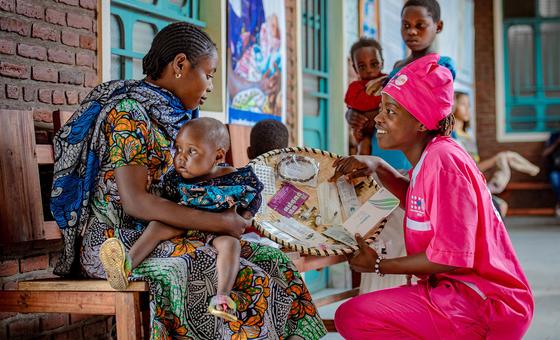
Around 224 million women still don’t access family planning
The increased use reflects a major health success that has allowed millions of young people to avoid unintended pregnancy and exercise choice over their futures, but UNFPA said that “for far too many, the basic human right to choose whether to have children continues to be undermined.”
‘Contraceptives save lives’
The unavailability of contraception leads to a rise in unintended pregnancies and higher rates of maternal deaths resulting from unsafe abortions, according to UNFPA.
The consequences extend far beyond health, contributing to increased adolescent pregnancies, school dropouts, and a heightened risk of gender-based violence.
“Contraceptives save lives”, reiterated Diene Keita, the UNFPA executive director.
In addition, they also yield significant economic benefits.
“Every $1 spent ending unmet need for contraception yields nearly $27 in economic benefits”, said Ms. Keita.
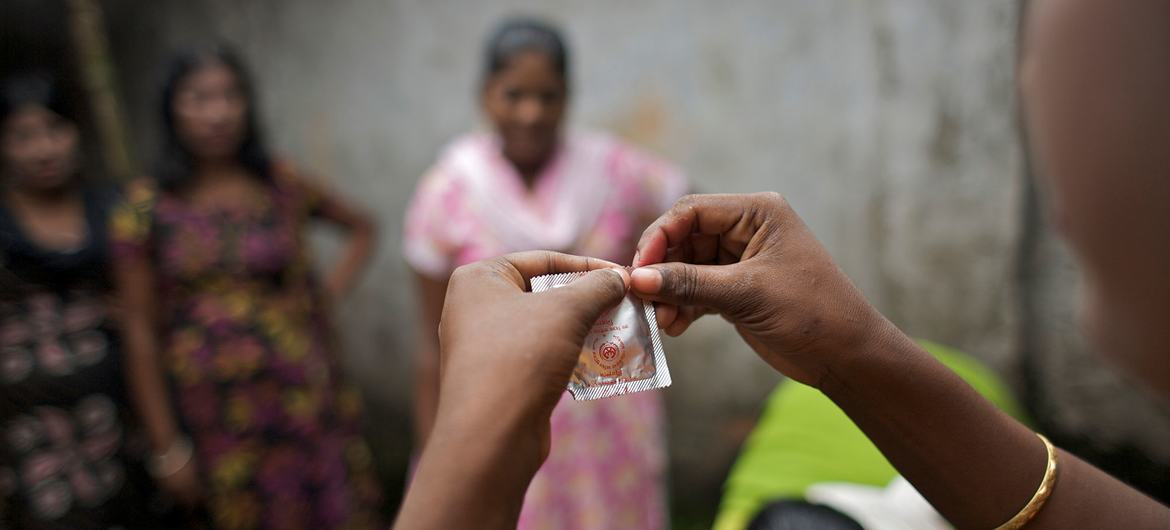
A peer educator speaks to a group of commercial sex workers in Bangladesh about the benefits of using condoms.
Here are five common myths about contraception.
1. Contraception is unsafe
Modern forms of contraception are among the “most prescribed and well-studied” medications in existence, according to UNFPA.
Health risks associated with unintended pregnancy are “significantly higher” than any recommended contraception method.
2. Using contraception can cause an abortion
Contraceptives do not cause abortion or miscarriage; they act by preventing fertilisation or ovulation – preventing pregnancy from happening in the first place.
3. Birth control damages your fertility
Contraceptives do not cause infertility. Some hormonal methods (such as injectable contraceptives) may temporarily delay the resumption of ovulation and menstruation, but it does not lead to permanent infertility.
4. Natural methods of family planning are safer than hormonal methods
Nowadays, alternative methods of contraception are becoming highly popular on social media – cycle tracking methods, fertility awareness methods (ie, daily checking of temperature).
These “natural methods” are “significantly less likely to prevent pregnancy”, underscored UNFPA. “The most effective methods of contraception are modern methods.”
5. You shouldn’t use contraception if you are single, or if your partner doesn’t want you to
Research shows that young people with access to information and services related to sexual and reproductive health do not increase their sexual activity.
Instead, it equips them with information to make responsible decisions.
“Every individual has the right to decide whether or not to become pregnant”, UNFPA said.
No one should ever be pressured into having unprotected sex — a form of reproductive coercion that the UNFPA has reiterated constitutes abuse.










Leave a comment