






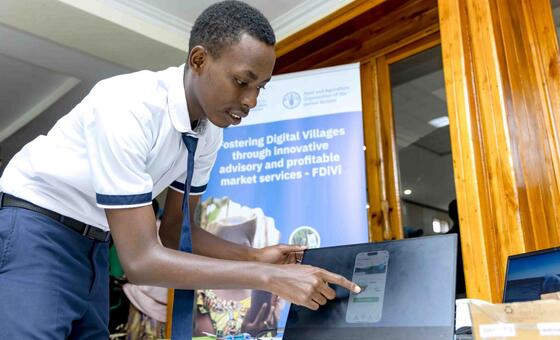
‘Ask us first’: Children demand a voice on AI’s future
“Today’s children are the first generation to grow up with artificial intelligence – yet often the last to be asked for their views,” UN High Commissioner for Human Rights Volker Türk told a high-level meeting in New York on protecting children in the age of AI, held on the sidelines of the General Debate.
Children, he insisted, must be treated as full rights-holders in how AI is built and used – not an afterthought once the technology has already shaped their lives.
The meeting was co-chaired by French President Emmanuel Macron, Spanish Prime Minister Pedro Sánchez, Kenyan President William Ruto and Australian Prime Minister Anthony Albanese.
What’s the worry?
Mr. Türk’s office, working with partners, surveyed more than 1,000 children across 49 countries.
Their answers paint a sharp picture of unease: fake images made of real people, personal data harvested and exploited, creativity quietly eroded, and a fear that AI could edge out real relationships with family, friends, teachers or therapists.
The throughline was simple. Children want to be heard before the decisions get made and not handed the results afterwards.
Building in safeguards
For Mr. Türk, the answer already exists on paper: the Convention on the Rights of the Child, the most widely ratified human rights treaty in the world, applies just as much to AI as to anything else.
That puts real obligations on the companies building these systems, he said – human rights risk assessments before products ever reach the market, genuine transparency and independent oversight, not self-policing.
Governments, too, have to do more than encourage good behaviour. “Voluntary commitments are not enough,” Mr. Türk warned.
The New York meeting builds on a coalition launched in Geneva in July, another wordy but important grouping known as the Coalition for Children’s Rights and Protection in the Age of Artificial Intelligence.
It brings together governments, UN agencies, tech companies, civil society groups and outside experts.
Seventeen countries have signed on so far. Its goal: get children themselves into the room when AI systems that shape their lives are designed, deployed and monitored.
“Children’s rights apply to AI,” Mr. Türk said, “just as they apply everywhere else.”
Sexualised images proliferate
For Catherine Russell, Executive Director of UNICEF, children are not hanging around waiting for adults to finish defining the rules: they are already using AI, which can offer them important opportunities to learn, create and access information and services.
But the risks are also considerable. According to UN Children’s Fund research, at least 1.2 million children in 11 countries saw their likenesses transformed into AI-generated sexual images during the past year.
She said there was no disguising the damage that AI is already doing to a whole generation of children, Ms. Russell said.





Leave a comment