






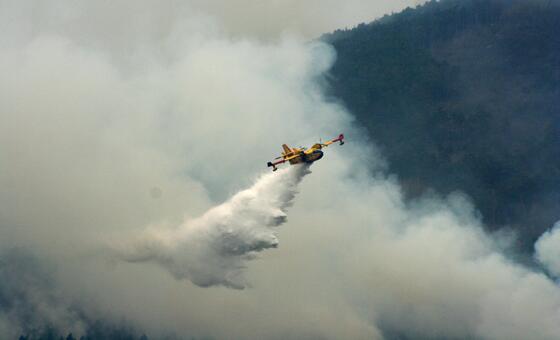
Wildfires: Prevention is the best defence, UN says
The warning comes from the UN Economic Commission for Europe (UNECE) which said that more than 434,000 hectares have already burned across Europe this year, according to latest available data.
“Every summer reminds us that wildfire is no longer an exceptional event but an increasingly predictable consequence of a warming climate,” said Paola Deda, Director of UNECE’s Environment and Forests Division.
“While emergency response remains essential, our greatest opportunity lies in prevention, sustainable forest management and building more resilient landscapes and communities.”
Forests destroyed, homes evacuated
In Europe, wildfires have destroyed some 42,000 hectares of pine forest in the Gironde region of France and forced tens of thousands of residents and tourists to evacuate.
Neighbouring Spain has recorded more than 200,000 hectares burned, or twice its historical average, making this one of the country’s worst wildfire seasons in decades.
The European Union (EU) recently warned that the wildfire crisis is moving eastwards, with Greece and Italy facing rising risks as heat, drought and strong winds continue into early August.
The situation across the Atlantic is equally severe. The United States has recorded roughly 1,849,000 hectares burned so far this year, while Canada has experienced more than 4,000 wildfires that have burned 3,770,000 hectares and dozens of large fires still remain out of control.
Far-reaching impacts
Although wildfires are often measured in the number of hectares burned, the human impact extends far beyond the forest edge.
Homes, infrastructure and livelihoods can be lost and entire communities forced to flee at short notice. Moreover, smoke can travel hundreds or even thousands of kilometres, affecting air quality and people far away.
The economic toll is also rising. In the EU alone, wildfires are estimated to cost around 2.5 billion Euros every year through damage to infrastructure, loss of tourism revenue and disruption to the wider economy.
Even after the flames have been extinguished, communities must deal with ecosystem degradation, biodiversity loss, reduced agricultural productivity, health impacts and the expensive restorations.
Human-driven crisis
Human activity remains the main cause of wildfires. Roughly nine out of 10 are caused by people – whether through negligence or deliberate acts.
This shows that many fires can be prevented through greater public awareness, stronger regulations, temporary restrictions during periods of extreme fire danger and responsible behaviour in forests and natural areas.
Meanwhile, climate change is making fires bigger and more destructive, as rising temperatures, prolonged droughts, more frequent heatwaves and changing rainfall patterns extend fire seasons and expose regions previously considered at low risk.
Wildfires are also accelerating the climate emergency. In 2021, they released an estimated 1.8 billion tonnes of carbon dioxide.
Between 2001 and 2023, global carbon emissions from wildfires jumped by approximately 60 per cent, while emissions from boreal forest fires in Europe, North America and Central Asia nearly tripled.
This creates a dangerous feedback loop, UNECE said, as climate change increases wildfire risk and larger wildfires release more greenhouse gases, further accelerating global warming.
Invest today for a safer tomorrow
Although extreme wildfires cannot always be stopped once they develop, their frequency and impacts can be significantly reduced.
UNECE called for greater investments in prevention, sustainable forest management, early warning, public awareness and climate adaptation to save lives, protect forests and reduce losses.
Technology, including artificial intelligence, is becoming an important tool in this regard, such as AI-powered detection systems in Türkiye, satellite monitoring and real-time risk mapping.
UNECE insisted, however, that technology alone will not be enough.
“As climate risks continue to grow, strengthening forest resilience to fire is no longer only an environmental priority – it is an investment in public safety, economic stability and climate security,” the Commission said.










Leave a comment