




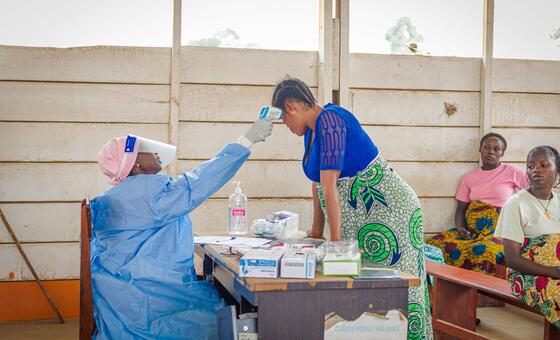
DR Congo: Ebola outbreak still expanding, WHO sees signs of stabilization
By Nathalie Minard, Geneva
In the Democratic Republic of the Congo (DRC), UN health teams and partners are still racing to contain the rapidly expanding Ebola outbreak, despite ongoing insecurity in eastern areas where the virus has taken hold. As of 19 July, the DRC Government has recorded 2,423 confirmed cases, including 967 deaths and 469 recoveries.
Key points
- Fastest-growing Ebola outbreak ever recorded.
- No approved vaccine or treatment exists.
- Violent instability hampering disease surveillance and care.
- Early detection remains critical to saving lives.
“The outbreak has been reported in five provinces, but the province of Ituri remains the epicentre of the outbreak, accounting for more than 90 per cent of cases and also 80 per cent of deaths,” said Dr. Thierno Baldé, World Health Organization (WHO) Incident Manager. In addition to Ituri, the other impacted provinces are North Kivu, South Kivu, Haut-Uele and Tshopo.
Speaking to journalists in Geneva from Bunia, capital of Ituri province and at the heart of the outbreak, Dr. Baldé confirmed that the Bundibugyo virus behind this latest Ebola outbreak is also extending its reach to new areas in the eastern region, where chronic instability and the threat of conflict have combined with highly mobile and often displaced populations to create ideal conditions for the infection to spread.
Rampant insecurity
Teams from WHO are adjusting and tailoring their strategy to the specific needs of each of the affected areas, while also focusing on bringing the situation under control in Bunia and surrounding areas.
The five affected provinces are all in eastern DRC where rebel militia violence remains rampant and communities live in fear of conflict.
“Let’s be very clear, this outbreak remains ahead of us and we are still in the phase of catching up,” explained Dr. Baldé. “We have prioritized the expansion of safe and dignified burials, [a] referral system [and] clinical case management capacity in the most active transmission areas,” he explained.
The Ebola outbreak that was declared in eastern DRC on 15 May is the fastest-growing Ebola outbreak on record. The Bundibugyo virus variant is less common and there is no approved vaccine or treatment.
Dr. Baldé described a recent visit to Kisangani in Tshopo province where WHO is implementing a collective strategy by deploying rapid response teams. The results are encouraging. “No secondary cases have been detected so far in Kisangani,” he said. “Currently, all five cases are imported from Ituri province. We intend to roll out a similar rapid response plan in…Katwa, Butembo and other emerging areas”, he added.
Congo River strategy
To tackle any chains of transmission, the UN health agency is also working on a new project which aims to reinforce control measures through the River Congo, “a crucial transit route requiring rapid implementation of control measures”, the WHO official explained.
WHO teams continue to engage actively with communities to mobilize and encourage them to accept treatment and follow-up care. “The main strategy is to implement a very strong, very effective and very timely response to contain the affected areas by identifying, by doing in-depth investigation of the cases, listing and following all of the contacts,” insisted Dr. Baldé.
Despite the challenges, WHO has reported some encouraging signs, such as in Mongbwalu, where the outbreak was first detected. “Mongbwalu is currently showing some signs of stabilization with a similar trend in Goma, North Kivu province,” noted the WHO Incident Manager.
The highly contagious Bundibugyo virus is relatively unfamiliar but it killed around 30 per cent of infected persons in the two previous outbreaks in 2007 and 2012, respectively in Uganda and DRC.
The disease starts with flu-like symptoms including fever which can mask its true identity. Full-blown Ebola disease caused by Bundibugyo virus is marked by severe bleeding and a fatality rate of around 40 per cent.








Leave a comment