







Miss the pandemic era of working from home? Give it a decade or two, and it’s set to be the norm again. That’s because, although baby boomer and Gen X bosses may be winning the return-to-office war right now, new data suggests it’s a short-lived victory.
In fact, the National Bureau of Economic Research found that millennial and Gen Z bosses are far more likely to let staff work remotely than their older counterparts—and that it’s only a matter of time before they take over and bring their affinity for flexibility with them.
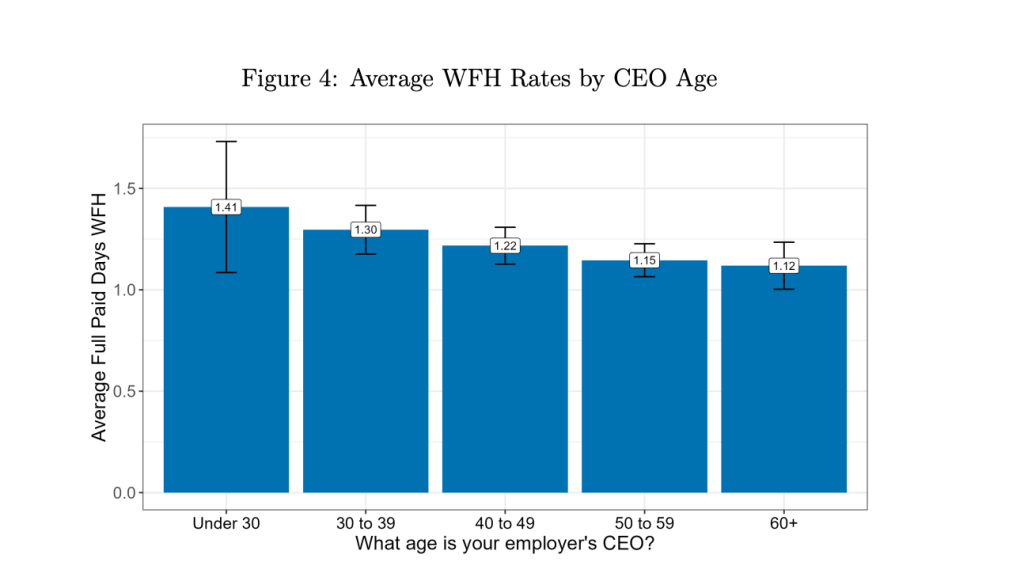
The researchers tracked monthly surveys of 8,000 U.S. workers aged 20 to 64 across 2025 and concluded that when it comes to flexible working, two things are consistently true: employees at younger firms, and under younger CEOs, spend significantly more time working from home.
“First, employees work from home more often at younger firms—almost twice as often at firms founded after 2015 as compared to those founded before 1990,” the researchers wrote. “Second, employees work from home more often at firms with younger CEOs.”
In fact, you can see in their data that as CEOs get younger, the number of days they demand staff work from an office decreases, with those working under a twenty-something-year-old chief working from home the most.
The National Bureau of Economic Research
It’s why the researchers concluded that work from home is poised to make a comeback, despite the likes of Amazon and JPMorgan currently mandating a full-time office return. As older leaders retire, the days of bums on seats five days a week are likely to fade with them.
In other words, your future commute may depend less on what HR says and more on the birth year of the person in the corner office.
And for workers who don’t want to wait, the study offers a simple hack: target younger firms with younger bosses if you want to maximize your chances of keeping your home office setup.
Gen Z bosses aren’t just flexible-first, they’re also digital-first
It’s not just that young bosses came of age during the pandemic’s remote work boom and see office cubicles as an outdated relic. Many of them built their businesses on Slack, Zoom, and AI tools, so flexibility and technology are baked into how their firms run—not bolted on as a perk.
The researchers found a clear correlation between younger CEOs and companies that are both flexible-first and digital-first, with leaders who embrace remote work also more likely to adopt new technologies and software-driven approaches to running their teams.
And that echoes what future-thinking CEOs have already been warning: Leaders who cling to the old ways of working aren’t serious about embracing AI.
“Forget about where people are working. Most companies will go by the wayside if they don’t embrace AI,” Mark Dixon, CEO and founder of International Workplace Group (IWG), exclusively told Fortune. “If you look at winners and losers, the winners are the ones that embrace the technology.”
“Embracing the whole of the technology, which is flexible work, flexible location, high levels of technology, using technology to get more out of your people. Those will be the winning companies, because they focus on the people,” Dixon warns.
As other leaders have pointed out, firms that focus on physical presence rather than remote, AI-driven work risk falling behind competitors.
Brian O’Kelley, the tech founder who sold AppNexus to AT&T for $1.6 billion in 2018, before founding Scope3, argued that remote firms, like his, have the top pick of top global talent and operate around the clock.
“The best companies are going to actually dump their offices to learn to work with non-bodied employees,” O’Kelley echoed in Fortune. “Anybody who has a back-to-office culture is actually hurting themselves.”
Being spread across time zones doesn’t just make his workforce available to customers at all hours of the day—it forces teams to be efficient and lean on the latest tech in ways traditional office-based companies simply don’t need to.
That’s why companies fixated on presence rather than productivity gains that actually enable an AI-first future are at a disadvantage.
“The thing is, if you build a culture that’s asynchronous and remote, it means you’re building a culture for AI to thrive,” O’Kelley added. “If you’re building an office culture, you are actually not building an AI-first ecosystem.”
This story was originally featured on Fortune.com









Leave a comment