



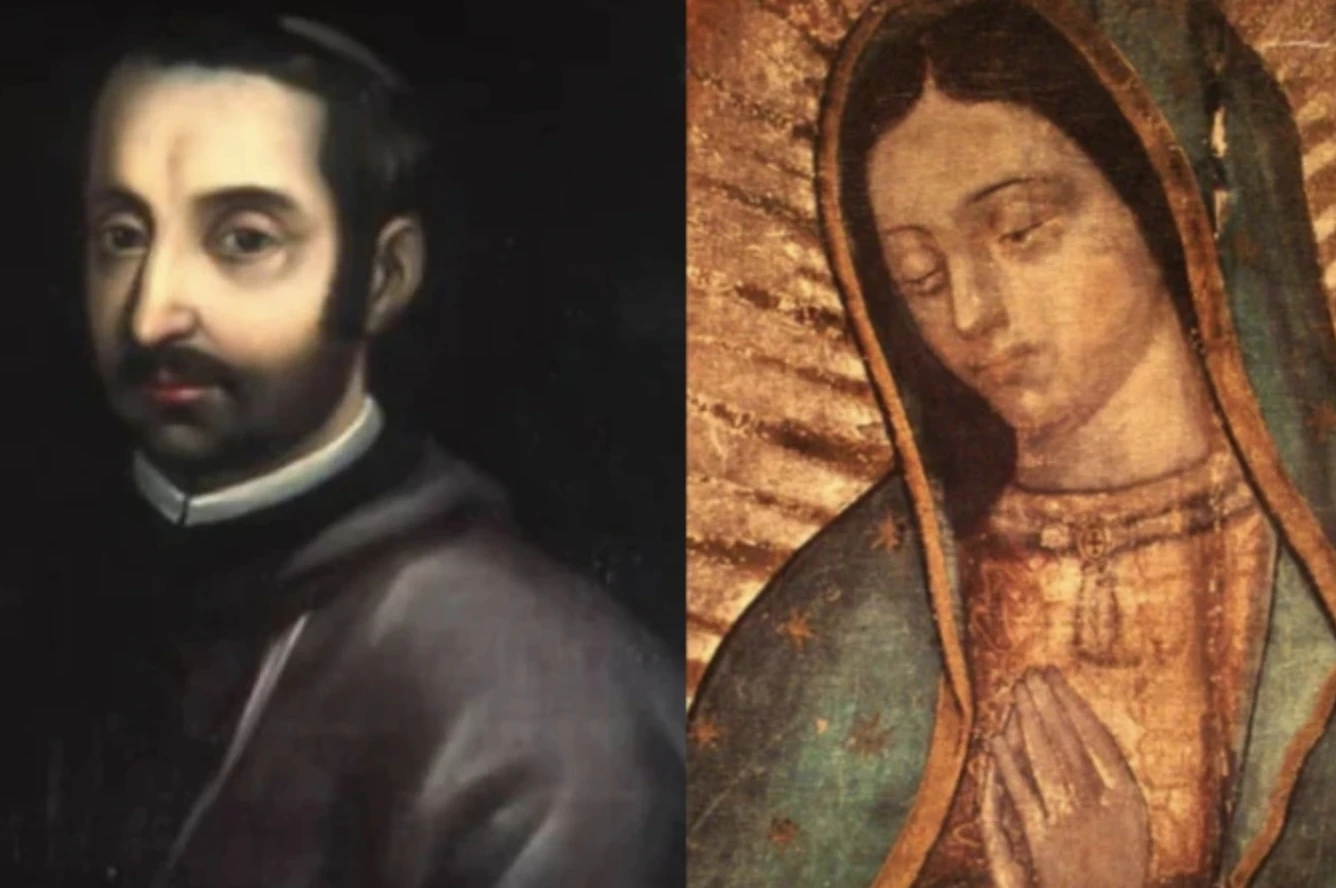

Blessed Juan de Palafox y Mendoza and Our Lady of Guadalupe. / Credit: Public domain ACI Prensa Staff, Nov 7, 2025 / 15:11 pm (CNA). Pope Leo XIV praised the missionary work of the Church in Mexico throughout history, inspired by the message of Our Lady of Guadalupe and the example of Blessed Juan de Palafox y Mendoza.In a message addressed to the participants of the 17th National Missionary Congress of Mexico, being held in Puebla Nov. 7–9, the Holy Father noted that the greatest privilege and duty of missionaries is “to bring Christ to the heart of every person.”Taking a closer look at missionary work, the pope offered the parable of the yeast from the Gospel of Matthew: “The kingdom of heaven is like yeast that a woman took and mixed with three measures of wheat flour until the whole batch was leavened” (Mt 13:33).In light of this verse, the pope explained that the “leaven of the Gospel” arrived in Mexico in the hands of a few missionaries: “These were the hands of the Church, which began to knead the leaven they carried with them — the deposit of faith — with the new flour of a continent that did not yet know the name of Christ.”The Holy Father noted that the Gospel “did not erase what it found but transformed it,” until it “took root in their hearts and blossomed into works of unique holiness and beauty.”Legacy of Our Lady of Guadalupe and Blessed Juan de Palafox y MendozaThe pope referred to the message of the Virgin Mary on Tepeyac Hill as “a sign of perfect inculturation” that God bestowed upon the Church, and noted that the message of Guadalupe provided “missionary momentum” for the first evangelizers, who “faithfully took up the task of doing what Christ commanded.”He also highlighted the figure of Blessed Juan de Palafox y Mendoza, whom he described as a “pastor and missionary who understood his ministry as service and leaven.”The Holy Father recalled his visit to Puebla as prior general of the Order of St. Augustine, where, he stated, the figure of Blessed Juan “remained alive in the memory of the people of Puebla; his [spiritual] fatherhood had left such a profound mark that it is still felt today in the simple faith of the faithful.”Palafox served as bishop of Puebla in the mid-1600s. For the pontiff, the example of the bishop challenges pastors today, “for it teaches that to govern is to serve, that to provide serious formation is to evangelize, and that all authority, when exercised according to the criteria of Christ, becomes a source of communion and hope.”Furthermore, as the pope pointed out, in his life and writings Palafox “shows that the true missionary does not dominate but loves; does not impose but serves; and does not exploit faith for personal gain.”Looking at the present, he lamented that “social divisions, the challenges of new technologies, and sincere desires for peace continue to be ground together like new flours that risk being fermented with bad yeast.”Therefore, he emphasized that today’s missionaries are called to be “the hands of the Church that place the leaven of the risen Lord in the dough of history, so that hope may be fermented anew.”“We must be willing to put our hands into the dough of the world! It is not enough to talk about the flour without getting our hands messed up; we must touch it,” he emphasized. He added: “This is how the kingdom will grow — not by force or numbers but by the patience of those who, with faith and love, continue kneading alongside God.”At the end of his message, the pope noted that the Catholic Church in Mexico “strives to live this call of Christ fully” and thus thanked the missionaries for their dedication.“May the Lord Jesus make all your initiatives fruitful and may Our Lady of Guadalupe, the Star of Evangelization, always accompany you with her motherly tenderness, showing you the way that leads to God,” he prayed.This story was first published by ACI Prensa, CNA’s Spanish-language news partner. It has been translated and adapted by CNA.








Leave a comment